Bitcoin Casinos in Canada 2026: How Crypto Deposits Work, Which Provinces Allow Them, and What to Check Before You Play Your First Hand
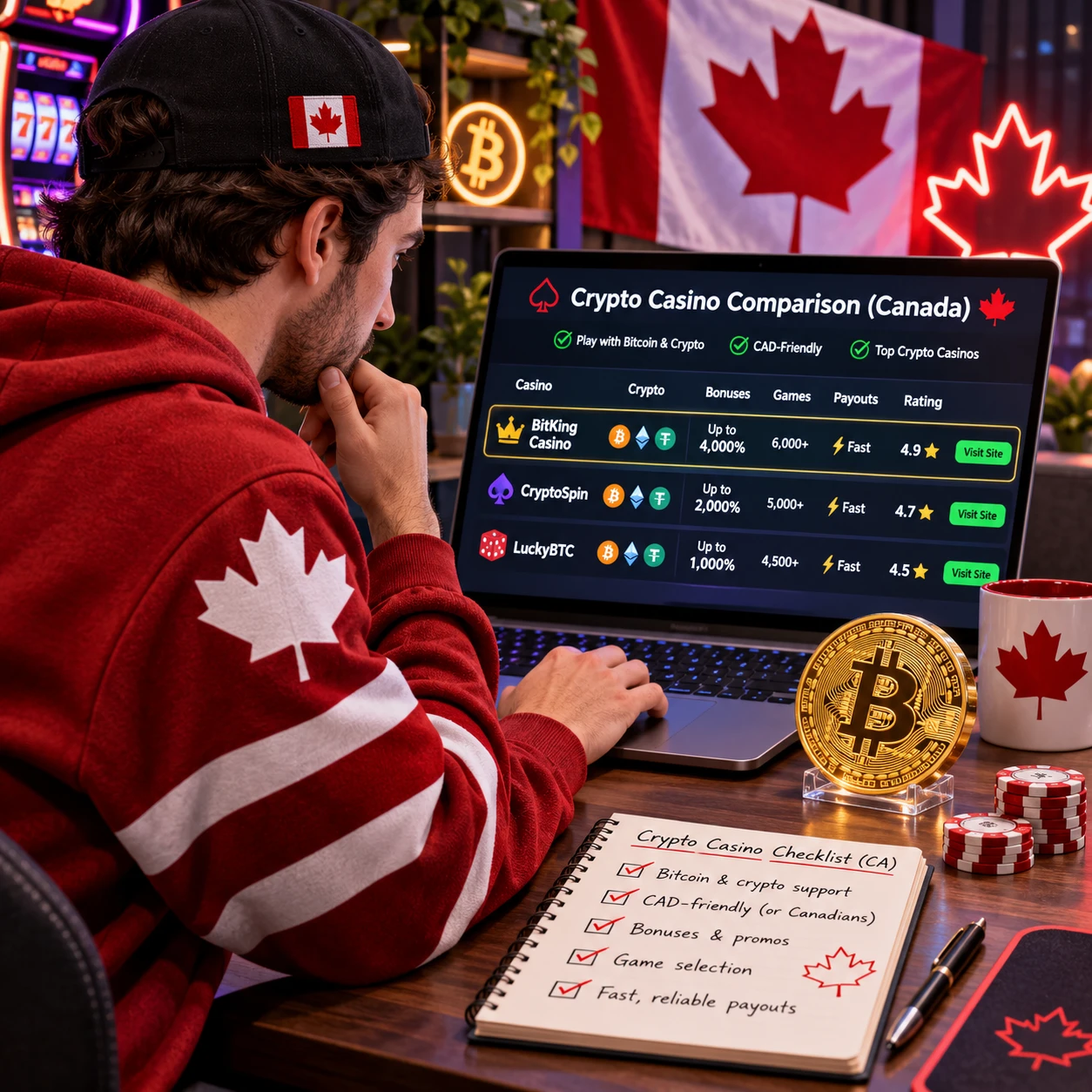
If you've gone looking for online gambling in Canada lately, you've probably noticed something weird. The ads and the search results just don't line up.
On one side you've got the federally sanctioned sportsbooks and the provincial iGaming sites — TV campaigns, hockey sponsorships, a regulator's logo sitting quietly down in the footer. On the other? A steady stream of crypto-only casinos taking Bitcoin, Tether and half a dozen other coins, turning up in every 'best casino' listicle, and almost never telling you who licenses them.
I've spent a lot of hours in the fine print on both kinds of site. And that gap — between how these places present themselves and what they actually are — is exactly where most Canadian players come unstuck.
So I'm not going to hand you a ranked list. A ranked list is stale inside a month, and it doesn't answer the questions that actually matter. Instead I want to walk through three things: how a crypto deposit really works, from the click on 'deposit' to the moment your balance moves; where these operators stand legally, province by province, in 2026; and what checks you should finish before you ever place a first hand.
One thing up front. Everything below assumes you're of legal gambling age where you live — 19+ across most of Canada, 18+ in Alberta and Manitoba. None of this is an endorsement of any operator, and none of it counts as legal or tax advice. I'm not your accountant and I'm definitely not your lawyer.
What a Bitcoin Casino Actually Is — and What It Isn't
Strip off the branding and the category is pretty simple. A Bitcoin casino is an online gambling site that accepts BTC — and usually a few other cryptocurrencies — and settles deposits and withdrawals on-chain instead of through Interac e-Transfer, a Visa card or a bank wire. That's the whole structural difference. Nothing more.
The confusion comes from shoving two very different things under one label.
First, you have provincially regulated iGaming sites. Licensed, audited, and in some cases they've quietly started taking crypto through a payment processor. Those aren't 'Bitcoin casinos' in any meaningful sense — they're regulated casinos that happen to tolerate crypto at the cashier.
Second, you have offshore casinos that list Bitcoin as one payment option out of twenty. Crypto-friendly, sure. Crypto-native, no.
The dividing line that matters isn't the payment rail. It's licensing. And it's who you can complain to when something goes sideways.
Custodial vs. non-custodial — where your coins actually sit
Here's the bit that surprises people. In almost every case, the casino holds your balance in its own wallet. The moment your deposit confirms, those coins aren't yours in any technical sense — they're an IOU on a ledger you can't audit. 'Not your keys, not your coins' applies the second the transaction settles. Fully.
You'll also see 'provably fair' badges slapped across these sites. Provably fair is a real cryptographic mechanism, and it lets you verify that a given game result wasn't tampered with after the fact. Fine. Genuinely useful, even.
What it does not do is prove the operator is licensed, solvent, or planning to pay you. A site can have perfectly verifiable dice rolls and still freeze your withdrawal on a Tuesday. Fairness and solvency are two separate questions, and only one of them gets answered by a hash.
How Crypto Deposits Work, Step by Step
The sequence is mechanical once you've done it a couple of times. The first run is where funds disappear. Here's the full path:
- Account creation. Email, password, sometimes a phone number. Plenty of operators let you register without verification — that comes later.
- Identity verification. Some sites ask up front, most put it off until your first withdrawal. Assume it's coming.
- Selecting a coin and network. This is the step people rush. You're picking two things here, not one.
- Generating a deposit address. The site spits out a wallet address, sometimes a QR code, sometimes with a countdown timer attached.
- Sending from your wallet or exchange. You paste the address, punch in the amount, confirm.
- Waiting for confirmations. Bitcoin mainnet typically wants two or three before crediting. Altcoins vary all over the place.
- Balance credited. Only now is the money actually available to play.
Two failure points account for the overwhelming majority of lost deposits. The first is wrong network selection — sending USDT on a chain the receiving address doesn't support, for instance. The second is address reuse across coins, where someone sends BTC to an address generated for ETH because the two looked similar.
Both are unrecoverable in practice. Not 'call support and sort it out' unrecoverable. Gone. I watched a friend do the second one in about eleven seconds flat, and there was nothing anyone could do afterward except stare at the explorer.
If a transaction stalls, don't panic and don't resend it. Check the transaction hash on a block explorer first. Unconfirmed means a fee or mempool issue, and it usually clears on its own. Confirmed but your casino balance hasn't moved? That's a support ticket with the hash attached.
Choosing the network matters more than choosing the coin
Beginners obsess over which coin to use. The network is the more consequential pick, and honestly it isn't close.
Bitcoin mainnet is secure but slow and expensive next to the alternatives. The Lightning Network moves BTC faster and cheaper, but only if the casino actually supports it. Stablecoin rails dodge price swings between deposit and play. A casino that only takes mainnet BTC isn't automatically worse — it's just slower and costlier per deposit.
Whatever you choose, the casino has to support the exact network you send on. 'We accept USDT' tells you nothing if it's the wrong chain.
And keep the central risk of this whole section in your head: on-chain transfers are irreversible. No chargeback. No dispute process. No card issuer to call.
Withdrawals, KYC, and the paper trail
Depositing with Bitcoin does not mean withdrawing anonymously. Most operators trigger full identity verification before a cash-out, especially on larger amounts, and some will ask for proof of address and a source-of-funds document. Read the withdrawal terms before you deposit. Not after you've won.
Separately, Canadian players still carry reporting obligations. Gambling winnings generally aren't taxable in Canada when they're not your profession, but crypto transactions have their own reporting rules, and a large on-chain movement is not invisible to the CRA. Talk to an accountant who understands crypto instead of trusting a forum thread from 2021.
Which Provinces Allow Bitcoin Casinos in 2026
This is the section most articles skip. It's also the one that actually matters.
Gambling in Canada is regulated provincially. The Criminal Code sets the federal framework that lets provinces conduct and manage gaming, and each province builds its own regime on top of that.
Ontario went the open-market route: iGaming Ontario licenses private operators to serve Ontario residents, and only those operators may legally do so. British Columbia, Quebec, Manitoba and the Atlantic provinces have largely kept online gambling inside their own crown corporations — PlayNow, Espacejeux and equivalents.
The distinction worth internalising: a site accepting Canadian players is not the same as a site licensed to serve them. Offshore operators that take Canadian registrations sit in a legal grey zone that shifts by province and by enforcement posture.
That's not a technicality. It's the difference between having a regulator to escalate to and having nobody at all.
Province-by-province snapshot
- Ontario: Open regulated market. Only iGO-licensed operators may legally offer online casino play to Ontarians. Crypto-accepting offshore sites are not licensed here.
- Quebec: Online gambling runs through Loto-Québec's Espacejeux. No open market for private operators.
- British Columbia: BCLC's PlayNow is the regulated channel. Private online casino operators are not licensed.
- Alberta: Alberta Gaming, Liquor and Cannabis oversees play; the province has been moving toward a more open iGaming model, so verify current status with AGLC. Legal age is 18.
- Manitoba: Online play through Manitoba Liquor & Lotteries. Legal age 18.
- Saskatchewan: Operated through SaskGaming and Lotteries Trust; no private online casino licensing.
- Atlantic provinces: Atlantic Lottery Corporation serves NL, NS, NB and PEI. Regulated online play flows through ALC.
Guidance changes. Before you commit money anywhere, check your provincial regulator's current list of licensed operators. That five-minute check is worth more than any review site you'll read this year.
What to Check Before You Play Your First Hand
Treat this as a pre-flight checklist, and don't skip a line just because the site looks polished. Polished is cheap.
- Who holds the licence, and with which regulator? If the answer isn't findable in thirty seconds, that's your answer.
- How long has the operator been running? Cross-reference independent reviews for a payout record — not affiliate sites that earn commission on signups.
- Withdrawal limits, processing times, and verification requirements. Know these before you deposit, not after.
- Are the bonus terms realistic? Most aren't, and I'll get to that.
Doing the comparison legwork before you commit funds is honestly the highest-return hour you'll spend on this. A useful starting point is a directory that documents how deposit and withdrawal flows actually work rather than just listing signup offers — the kind of breakdown you'll find in this overview of bitcoin casinos, which covers the mechanics alongside the operator details. Use it to build a shortlist, then verify every name against the regulator yourself.
Reading the bonus terms without getting burned
A '200% match up to 5 BTC' headline tells you almost nothing.
What matters is the wagering requirement (how many times you must bet the bonus before withdrawing — 40x is common and punishing), game weighting (slots usually count 100%, table games often 10% or 0%), max-bet rules during playthrough (often $5 or the equivalent, and breaching it can void the bonus), and the expiry window, which is frequently measured in days.
Run the arithmetic before you accept anything. A 1 BTC bonus at 40x wagering means 40 BTC of turnover. If that number makes you wince, the bonus isn't a gift. It's a commitment.
Common Mistakes New Crypto Players Make
- Sending on the wrong chain. Fix: copy the address and network together, then check both on the sending side before confirming.
- Treating a casino balance like a self-custody wallet. Fix: withdraw winnings promptly; don't park coins on an operator's ledger.
- Skipping the licence check because the site looks professional. Fix: design is cheap, licensing isn't. Look for a regulator, not a logo.
- Chasing bonus wagering past a sensible budget. Fix: decide the number before you start, and walk away from the bonus if it exceeds it.
- Ignoring provincial rules. Fix: confirm your province's regime first — it governs whether you have any recourse.
Playing Responsibly and Knowing Where to Get Help
Set deposit limits before your first bet, not after a bad session. Crypto's speed and irreversibility mean losses compound faster than they do with card deposits — no cooling-off period, no pending transaction to cancel, no issuer to step in.
Operators licensed in regulated markets are required to offer responsible-gambling tools: deposit limits, session timers, self-exclusion. If an offshore site offers none of those, the absence is itself a red flag about how it views its players.
In Canada, provincial regulators run self-exclusion programs, and national helplines are there for anyone who needs them. Use them without embarrassment. That's the whole point of them existing.
Frequently Asked Questions
Is Bitcoin legal in Canada?
Yes. Buying, holding and transacting in Bitcoin is legal. Crypto exchanges are registered as money services businesses with FINTRAC.
Are crypto casinos legal here?
It depends entirely on your province and the operator's licensing. Ontario permits only iGO-licensed sites; most other provinces channel online play through crown corporations. Offshore crypto casinos serving Canadians sit in a grey zone — check with your provincial regulator.
Can I be taxed on winnings?
Casual gambling winnings generally aren't taxable in Canada, but professional-level play can be, and crypto dispositions carry their own reporting obligations. Speak to a tax professional.
What if a site refuses to pay out?
With a licensed operator, you escalate to the regulator. With an unlicensed offshore site, your options are essentially limited to the operator's own complaints process — which is exactly why the licence check matters.
Do I need to verify my identity?
Almost certainly, at least before withdrawing. Depositing is often frictionless; cashing out is not.
Which coin is cheapest to deposit?
Usually a stablecoin on a low-fee network, or BTC over Lightning where it's supported. Confirm the casino supports the exact network before you send.
Conclusion
The technology here is genuinely straightforward — pick a coin, pick the right network, send, wait, play. The legal picture isn't, and that's where the real risk sits. The operators worth your time are the ones that survive scrutiny on licensing, withdrawal terms and dispute resolution, not the ones waving the flashiest welcome offer.
Verify your province's rules before you deposit. Read the withdrawal terms before you deposit. Set your limit before you deposit. Do those three things and you'll avoid nearly every story that ends badly.
Gambling should be entertainment funded by money you can afford to lose. If it stops being that, stop. And a reminder: you must be 19+ to play in Canada, or 18+ in Alberta and Manitoba.